


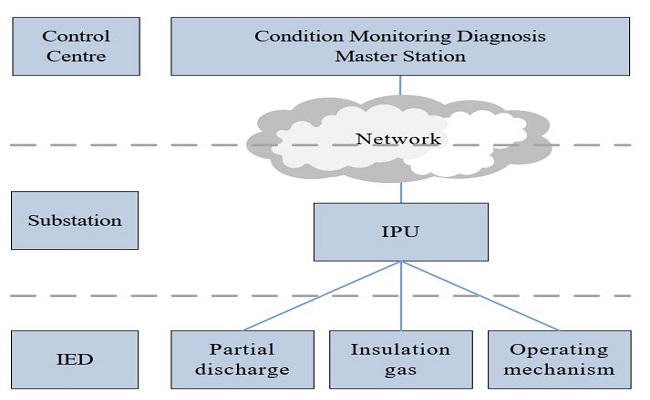
As electrical networks continue to evolve toward fully automated, data-driven ecosystems, the way we manage and monitor switchgear must keep pace. In recent years, a significant shift has occurred inside substations: protective relays, controllers, and condition monitoring devices have moved from isolated, proprietary systems toward harmonised digital architectures built around the IEC 61850 standard.
What was once a protocol aimed at interoperability has now become the central nervous system for modern grid automation.
The content of the work provides a comprehensive and practical view of how IEC 61850 models, logical nodes, and communication services support lifecycle management of switchgear assets.
This article translates that technical foundation into clear guidance for practitioners facing the growing need for intelligent monitoring, data integration, and predictive maintenance.
Why IEC 61850 Matters for Switchgear Health and Lifecycle Management:
Switchgear is exposed to a wide range of stresses: mechanical fatigue, insulation degradation, thermal cycling, gas pressure variation, partial discharge activity, and environmental contamination. Historically, utilities have monitored these conditions through standalone devices that lacked unified data structures.
IEC 61850 changes this by offering:
A common data model to represent electrical equipment and monitoring functions
Logical Nodes (LNs) that define how switchgear behavior, status, and health are communicated
High-speed messaging (GOOSE, SMV) for real-time supervision
Standardized system configuration (SCL) for interoperable engineering processes
This architecture allows utilities to consolidate monitoring information into a unified framework, regardless of manufacturer or device origin.
Logical Nodes: The Language of Digital Switchgear:
IEC 61850 models physical equipment as Logical Nodes (LNs)—structured, functional building blocks representing both primary equipment and monitoring functions. Each LN uses a four-letter code, where the first letter defines its group, such as X for switchgear or S for supervision and monitoring.
For example:
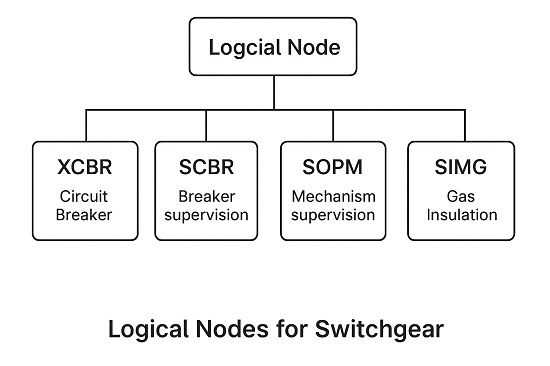
XCBR – Circuit breaker
SIML – Liquid insulation medium supervision
SARC – Arc detection monitoring
SPDC – Partial discharge monitoring
SOPM – Operating mechanism supervision
SCBR – Circuit breaker supervision
These LNs provide a digital representation of both the equipment and its health indicators. They contain Data Objects and Data Attributes, each with functional constraints such as:
ST (status)
MX (measurement)
SP / SG (settings)
CO (control)
This structured design ensures consistent communication of measurements, alarms, counters, and diagnostic parameters.
Modeling Condition Monitoring with IEC 61850:
A modern condition monitoring system is represented as an IEC 61850 server containing multiple Logical Devices and Logical Nodes aligned to real equipment functions. The functional hierarchy described in the material establishes how a complex device—such as a breaker monitoring system—can contain multiple sub-functions, each represented by specific LNs.
For example, a circuit breaker monitoring function may include:
Operation count (SCBR)
Gas pressure supervision (SIMG)
Mechanism performance (SOPM)
Partial discharge diagnostics (SPDC)
Each element becomes part of a larger decision-support system for assessing breaker health.
Table 1 – Key Logical Nodes Relevant to Switchgear Condition Monitoring:
| Logical Node | Function | Typical Role in Monitoring |
|---|---|---|
| XCBR | Circuit breaker | Status, position, operational state |
| SCBR | Breaker supervision | Operation counters, trip status tracking |
| SOPM | Mechanism supervision | Spring charge status, motor behavior, and mechanism wear |
| SIMG / SIML | Gas or liquid insulation supervision | Density, pressure, and leakage detection |
| SPDC | Partial discharge diagnostics | PD intensity, pulses, and insulation stress indicators |
| SARC | Arc monitoring | Detection of internal arcs, flashover indicators |
| STMP / SVBR | Temperature and vibration | Thermal aging, mechanical integrity assessment |
These LNs enable the analysis of asset condition through a consistent digital structure, allowing for automated diagnostics, lifecycle trending, and integration with enterprise asset management systems.
The Role of Sensors and Process Interface Nodes:
IEC 61850 includes a set of T-group Logical Nodes representing instrument transformers and sensors used to feed measured values into protection and monitoring logic. Examples include:
TCTR – Current sensor
TVTR – Voltage sensor
TTMP – Temperature
TPRS – Pressure
TMVM – Movement
TVBR – Vibration
TANG – Angle sensor
With these sensor nodes, the system can create a complete view of switchgear health by linking process measurements to higher-level diagnostic functions.
High-Speed Peer-to-Peer Communications: GOOSE and SMV:
One of the breakthroughs of IEC 61850 is its support for real-time messaging:
GOOSE (IEC 61850-8-1) – event-driven, repeated immediately after state changes
SMV (IEC 61850-9-2) – continuously streamed sampled values
These services enable distributed monitoring applications. For example, when an XCBR node detects that a breaker has tripped, it can immediately publish a GOOSE message that an SCBR supervision function in another device can use to update operation counters or trigger diagnostics.
Health Index Integration: Bridging Condition Data and Lifecycle Decisions:
A major topic in switchgear lifecycle management is the introduction of a standard Asset Health Index (AHI). The working group agreed on a practical scale of five levels, ranging from “Very Good” to “Critical”, which provides a unified framework for ranking asset condition, prioritizing maintenance, and planning replacements.
These five states are:
Very Good
Good
Fair
Poor
Critical
This simple scale balances clarity, precision, and practicality for utilities managing large fleets of breakers, disconnectors, and instrumented bays.
Table 2 – Example Mapping of Switchgear Monitoring Results to AHI Levels:
| Monitoring Indicator | Typical Behavior | AHI Level | Interpretation |
|---|---|---|---|
| Gas pressure stable, no PD, normal mechanism timing | Healthy state | 1 – Very Good | No intervention required |
| Minor timing deviation, slight vibration increase | Aging but stable | 2 – Good | Routine monitoring |
| Increased operating time, pressure trending low | Early deterioration | 3 – Fair | Plan maintenance |
| Frequent alarms, PD rise, mechanism wear | Significant degradation | 4 – Poor | Maintenance required soon |
| Trip failures, severe leakage, arc events | Critical failure mode | 5 – Critical | Immediate repair or replacement |
Conclusion: A Standard That Enables a Smarter, Longer-Lived Grid:
IEC 61850 is far more than a communication standard—it is a data architecture for the entire lifecycle of T&D switchgear. The combination of Logical Nodes, structured data models, real-time messaging, and asset-health integration gives utilities the capability to:
Streamline condition monitoring
Enhance maintenance planning
Reduce unexpected failures
Improve switchgear longevity
Enable advanced analytics and digital transformation
For asset managers and engineering teams, embracing this model means unlocking the full value of modern monitoring technologies while preparing substations for the next wave of digital innovation.